
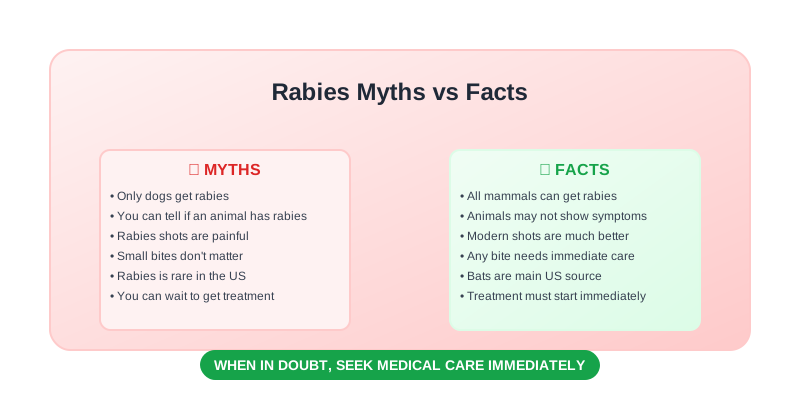
Why Squirrels Rarely Carry Rabies
Rabies is more commonly found in species that survive long enough to transmit virus, such as dogs, bats, raccoons, and foxes. Squirrels are small prey animals and are less likely to survive encounters with rabid predators.
Because of this, squirrel rabies transmission is considered very uncommon in most settings.
Is There Any Risk at All?
Risk is low, but not absolutely zero in every circumstance.
- Unprovoked aggressive behavior
- Disorientation or unusual neurologic appearance
- Deep bite wounds with heavy bleeding
- Visible illness in the animal
When any of these factors are present, seek prompt medical evaluation.
What to Do After a Squirrel Bite or Scratch
1. Clean the Wound Immediately
Wash with soap and running water for at least 15 minutes.
2. Apply Antiseptic
Use an antiseptic to reduce bacterial contamination risk.
3. Assess Exposure Context
Consider whether the encounter was provoked and whether the animal behavior seemed normal.
4. Get Medical Advice If Unsure
If the wound is deep, contaminated, or risk details are unclear, consult a clinician right away.
See what to do after a bite for complete first-aid and next-step guidance.
Other Risks Besides Rabies
Bacterial infection is often a more common concern than rabies in squirrel bites. Proper wound care and follow-up reduce complication risk.
Squirrels vs Higher-Risk Animals
- Higher risk species: dogs, bats, raccoons, foxes
- Lower risk species: squirrels, rabbits, mice
When to Be More Concerned
- Unprovoked attack
- Markedly abnormal animal behavior
- Severe wound or uncontrolled bleeding
How to Avoid Squirrel Bites
- Avoid hand-feeding wildlife
- Do not handle injured wild animals
- Teach children to maintain distance
Why Small Rodents Almost Never Have Rabies
Squirrels are part of a broader group — small rodents — that CDC surveillance has consistently shown to carry essentially no documented rabies transmission risk to humans. The biology comes down to body size and survival: for a small rodent to develop transmissible rabies, it would need to be bitten by a larger rabid mammal and live long enough for the virus to replicate, travel along nerves, and reach the salivary glands. This process takes weeks, and most predator-prey encounters involving rabid wildlife kill the rodent outright before that can happen.
What About Larger Rodents?
The rule changes for larger rodents. Groundhogs (woodchucks) in particular have been documented as a meaningful rabies source in the eastern US — CDC reported that woodchucks accounted for 93% of rabies cases in rodents from 1990-1996 in raccoon variant zones. Beavers and capybaras have also been documented. The 'small rodent' rule does not extend to these species.
For the comparable rats and mice picture, see do rats and mice carry rabies.
What to Do After a Squirrel Bite or Scratch
Bacterial wound infection is the realistic concern, not rabies. Steps:
- Wash the wound with soap and water for at least 15 minutes.
- Apply antiseptic and a clean dressing.
- Check your tetanus booster history; update if last shot was 5+ years ago.
- Watch for redness, swelling, warmth, or pus over the next 1-3 days.
- See a clinician if the bite is deep, on the hand or face, or shows signs of infection.
For broader bite first-aid, see what to do after a bite.
Where Squirrels Sit in the Wildlife Rabies Picture
- Squirrels and other small rodents: essentially zero documented rabies transmission to humans.
- Opossums: very low risk because of cool body temperature — see can opossums get rabies.
- Bats: highest US risk — see bat exposure.
- Raccoons, skunks, foxes: primary US wildlife reservoirs — see raccoons, skunks, foxes.
- Birds: cannot get or transmit rabies — see can birds get rabies.
Related Guides on SafeRabies
When Squirrel Bites Have Required Evaluation
Although squirrel-to-human rabies transmission is not documented in modern US surveillance, individual squirrel bites can still warrant public health review when:
- The squirrel was visibly sick or behaving abnormally before the encounter
- The bite occurred during a heavy regional rabies outbreak in larger species (raccoons or skunks)
- The bite recipient is severely immunocompromised
In these edge cases, your local health department may recommend evaluation even though the species itself is low-risk. Contact public health rather than self-assess if any of these apply.
Sciurid Family Across the US
Tree squirrels (eastern gray, fox, red), ground squirrels, chipmunks, and prairie dogs all fall in the small-rodent category and follow the same essentially-no-rabies-risk pattern. Larger ground squirrels and prairie dogs occasionally appear in surveillance, but human transmission has not been documented from any of these species.
Public Health Stance Across States
State public health departments uniformly classify squirrels among the small-rodent group that does not require post-exposure rabies treatment after typical bites. The few exceptions are tied to local outbreak conditions or atypical animal behaviour. If you are unsure, calling your state rabies coordinator gives a definitive answer faster than self-research.