
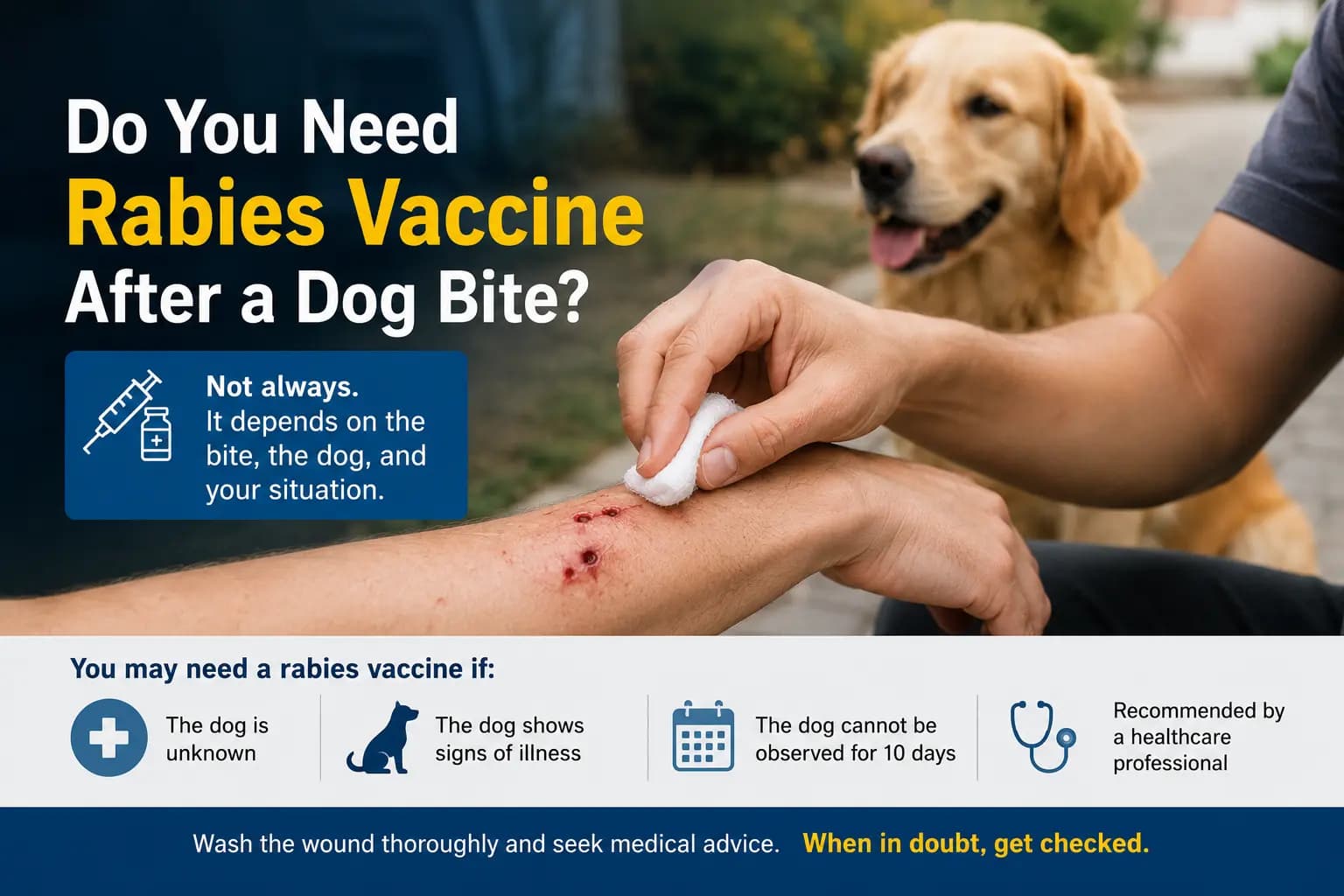
After a possible exposure: Seek prompt professional assessment; do not wait for observation to finish. Public-health authorities can arrange a full 10-day observation for an eligible dog, cat, or ferret and use the result to guide PEP. Do not start, delay, or stop PEP on your own. A clinician or public-health professional should assess the animal, type of contact, wound depth and site, where the encounter happened and local rabies activity, and options for observation or testing.
How Is Rabies Risk Determined?
The need for a rabies vaccine depends on several factors. Doctors do not make decisions based on guesswork. They assess specific conditions around the bite.
1. Type of Animal
Dogs are one of the most common sources of rabies transmission worldwide. However, risk varies depending on whether the animal is domestic or stray.
2. Vaccination Status
A properly vaccinated dog significantly lowers risk. If vaccination status is unknown or unreliable, caution is necessary.
3. Severity of the Bite
Even a small, non-bleeding scratch can be an exposure. Wound depth and site matter, but visible bleeding is not required for professional assessment.
Understanding the PEP Guides
This article explains the factors healthcare professionals and public-health authorities consider when assessing whether rabies post-exposure treatment may be indicated after a bite. If a healthcare professional or public-health authority has recommended treatment, two other SafeRabies guides cover the specific protocols:
- You are here: Dog bite rabies PEP assessment factors (assessment framework)
- Human rabies PEP for unvaccinated people — the full 4-dose schedule plus HRIG for people never previously vaccinated.
- Human rabies PEP for previously vaccinated people — the abbreviated 2-dose booster schedule with no HRIG for people who have completed the rabies vaccine series before.
When Prompt Assessment Is Important
Seek prompt medical or public-health assessment in the following situations:
- The dog is stray, aggressive, or cannot be identified
- The bite causes bleeding or deep tissue damage
- The dog cannot be observed for 10 days
- The animal shows unusual behavior such as drooling, confusion, or aggression
In these cases, seek prompt medical or public-health assessment. A healthcare professional or public-health authority should determine whether PEP is indicated and when care should begin.
Situations Professionals May Assess Differently
Risk may be lower in these situations:
- The dog is fully vaccinated and healthy
- The bite is minor and does not break the skin deeply
- The animal can be observed for 10 days and remains normal
Professional or public-health assessment is still recommended because the appropriate response depends on the complete exposure details.

What Should You Do Immediately After a Dog Bite?
Clean the Wound
Wash and flush the area thoroughly with soap and running water for about 15 minutes when possible. This can greatly reduce infection risk.
Disinfect the Area
Apply an antiseptic solution to reduce bacterial and viral contamination.

Seek Medical Advice
A healthcare provider should assess the exposure and guide whether vaccination is necessary.
Learn more about what to do after a bite and the rabies vaccine guide for next steps.
What Is Post-Exposure Prophylaxis (PEP)?
Post-exposure prophylaxis (PEP) is preventive treatment after possible rabies exposure. It includes a vaccine series and in some cases rabies immunoglobulin for immediate protection.

If the Dog Is a Stray
A stray dog bite that breaks skin is often treated as a higher-concern exposure because the animal’s vaccination status and observation status may be unknown. The dog's vaccination status and wildlife contact history are unknown, and the standard 10-day observation often is not possible because the dog cannot be located. Public-health or clinical guidance may recommend starting PEP while the animal’s status is unresolved. Only a healthcare professional or public-health authority should decide whether to continue or stop PEP. See stray dog bite: rabies risk and what to do for the full protocol.
If You Were Only Scratched, Not Bitten
Bites and scratches carry different risk profiles. Rabies transmission requires saliva contact with broken skin, which bites deliver directly but scratches only sometimes do (when claws are freshly contaminated by saliva). Seek prompt advice after a skin-breaking scratch, even from a vaccinated pet. You cannot reliably establish saliva contamination from the appearance of the wound. Stray or ill animals require prompt professional or public-health assessment. See can you get rabies from a dog scratch.
What If the Dog Is Owned but Vaccination Status Is Unclear
Most US states have laws requiring owner cooperation in bite incidents. If the owner cannot or will not produce vaccination records, the dog is legally treated as unvaccinated until records appear. Animal control has authority to enforce quarantine. See the 10-day observation rule for the framework.
How Much Does PEP Cost If You Need It?
US rabies care costs depend on the professionally confirmed plan and the provider. Ask for an itemized quote covering vaccine doses, HRIG when indicated, administration, consultation, facility charges and any testing. Confirm insurance benefits and patient responsibility directly; coverage does not establish a fixed out-of-pocket amount. Discuss treatment changes or delays with the treating professional. Related guide: rabies vaccine cost for humans.
Related Guides on SafeRabies
- Stray dog bite: rabies risk and what to do
- The 10-day observation rule
- After a vaccinated dog bite
- Dog scratch rabies risk
- How to know if a dog has rabies
What to Do in the First 60 Minutes
The first hour after a bite is when the wound-washing step has its biggest effect. The CDC recommends washing and flushing with soap and running water for about 15 minutes when possible, and laboratory data suggests this alone significantly reduces transmission risk. Apply povidone-iodine or another antiseptic after washing. Then assess the dog and decide on next steps; do not delay washing while you decide.
How Clinicians Document a PEP Assessment
A clinician or public-health authority considers the exposure category, dog status, and local rabies activity when deciding whether PEP is indicated. Ask how to follow up if the animal's status or other details change.
Bitten by a different animal? Use our full do I need a rabies shot? decision guide covering every species and exposure type.