
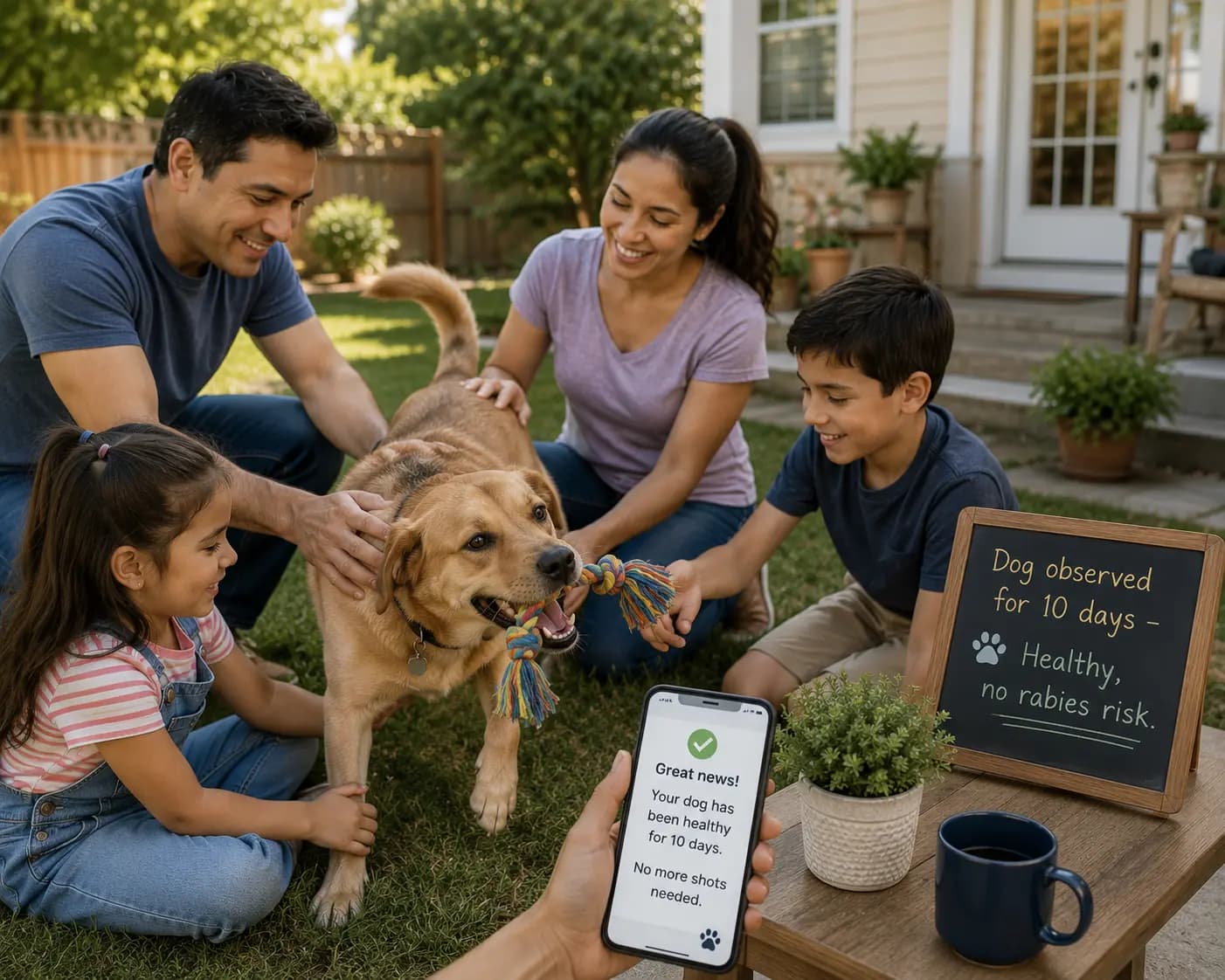
After a possible exposure: Seek prompt professional assessment; do not wait for observation to finish. Public-health authorities can arrange a full 10-day observation for an eligible dog, cat, or ferret and use the result to guide PEP. Do not start, delay, or stop PEP on your own. A clinician or public-health professional should assess the animal, type of contact, wound depth and site, where the encounter happened and local rabies activity, and options for observation or testing.
One of the most common questions after a dog bite is whether the dog has to be watched for 10 days and what that actually means for rabies risk. People hear 10-day quarantine or 10-day observation and often misunderstand it. Some think it means the bite is automatically safe. Others think it means rabies shots should always start immediately no matter what. The truth is more specific.
For dogs, cats, and ferrets, public-health guidance uses a 10-day observation period because if the animal remains healthy for those 10 days after the bite, it was not shedding rabies virus in saliva at the time of the exposure. CDC guidance notes that an animal in these species that stays healthy for 10 days after the exposure event is considered not to have been infectious for rabies at the time of the exposure.

What the 10-Day Observation Rule Actually Means
The purpose of the 10-day observation period is not to treat the dog or to prove the dog will never get rabies in the future. It is to answer a very specific question: was the dog infectious with rabies at the time it bit the person? For dogs, cats, and ferrets, the 10-day rule is used because rabies virus can be present in saliva during illness and for a short period before clinical signs appear. If the animal is still healthy 10 days later, it was not infectious at the time of the bite.
This rule is one of the most important trust-building concepts in dog-bite rabies care, because it explains why not every dog bite automatically leads to immediate rabies shots. At the same time, it does not mean every person can safely wait without guidance. The situation still has to be evaluated properly.
Which Animals the Rule Applies To
The 10-day observation rule is used for dogs, cats, and ferrets. It does not apply the same way to wild animals or to most other animal species. That is one reason bat exposure, stray wildlife exposure, and other unusual bites need a different decision path.

Does the Dog Have to Look Healthy, and Does Vaccination Matter?
Does the Dog Have to Look Healthy at the Start?
Yes, that matters. The 10-day rule is intended for a dog that appears healthy at the time of the bite and is available for confinement and observation. If the dog is already obviously ill, neurologically abnormal, or behaving in a way that suggests possible rabies, the situation becomes more urgent and should be handled with public-health involvement right away.

Does the 10-Day Rule Apply to Vaccinated Dogs Too?
Yes. Even vaccinated dogs that bite a person are generally observed for 10 days. Vaccination lowers risk but does not automatically remove the need for observation after a human exposure.
That is why a vaccinated dog bite still deserves proper assessment. If you want that scenario explained separately, read Vaccinated Dog Bite: Rabies Risk and What to Do.
Does Observation Replace Rabies PEP?
Not automatically. The observation rule is helpful, but the clinical decision still depends on the bite, the dog, how quickly the dog can be observed, local rabies risk, and public-health guidance.
In lower-risk domestic dog situations, it is often acceptable to defer rabies treatment while the dog is under immediate observation. But some bites are more urgent, especially bites to the face or head, or bites involving young children. That is why the right approach is not always wait or always treat immediately. The right approach is prompt assessment.
If the Dog Gets Sick or Cannot Be Found
What If the Dog Gets Sick During Observation?
If the dog becomes ill during the 10-day period, especially with signs that could suggest rabies, public-health authorities should be contacted immediately and the animal should be evaluated right away.
Then the observation rule may not help you. If the dog is not available for confinement, observation, or testing, the rabies risk decision becomes more cautious and may require starting PEP depending on exposure details and local guidance.
What to Do After a Dog Bite While Observation Is Sorted Out
Even if the dog is available for 10-day observation, your immediate steps still matter:
- Wash the wound immediately with soap and water.
- Get medical advice promptly if the bite broke the skin.
- Report the bite if local rules require it or if the dog's status is uncertain.
- Confirm whether the dog can truly be confined and observed under local public-health guidance.
- Do not self-decide to skip care just because the dog looked fine.
For the full immediate action path, go to What to Do After a Bite. If you want a decision aid, use the rabies exposure checklist.
Common Misunderstandings and Questions
If the dog is vaccinated, there is no need for observation
Incorrect. Vaccinated dogs that bite are still generally observed for 10 days.
The 10-day rule applies to all animals
No. The rule is for dogs, cats, and ferrets, not for all wildlife or every mammal.
If the bite is severe, I should just wait for the 10 days to end
No. Severe wounds and certain concerning scenarios need urgent medical attention and sometimes faster rabies decisions.
If the dog looked healthy for one day, I am safe
The rule is specifically about the full 10-day observation period, not a casual short-term impression.
Frequently Asked Questions
Final Thoughts
The 10-day dog observation rule is one of the most useful trust-building parts of rabies bite guidance because it explains why many dog bites do not automatically mean immediate rabies shots. But it only helps when the right conditions are met: the dog is healthy, available, and actually observed properly under local guidance.
The safest mindset is simple: wash the wound, get prompt advice, make sure the dog's status is being handled correctly, and do not confuse observation is possible with medical assessment is unnecessary.

Related Resources
- What to Do After a Bite
- Vaccinated Dog Bite: Rabies Risk and What to Do
- Dog Bite Rabies PEP Assessment Factors
- Rabies Symptoms Guide