
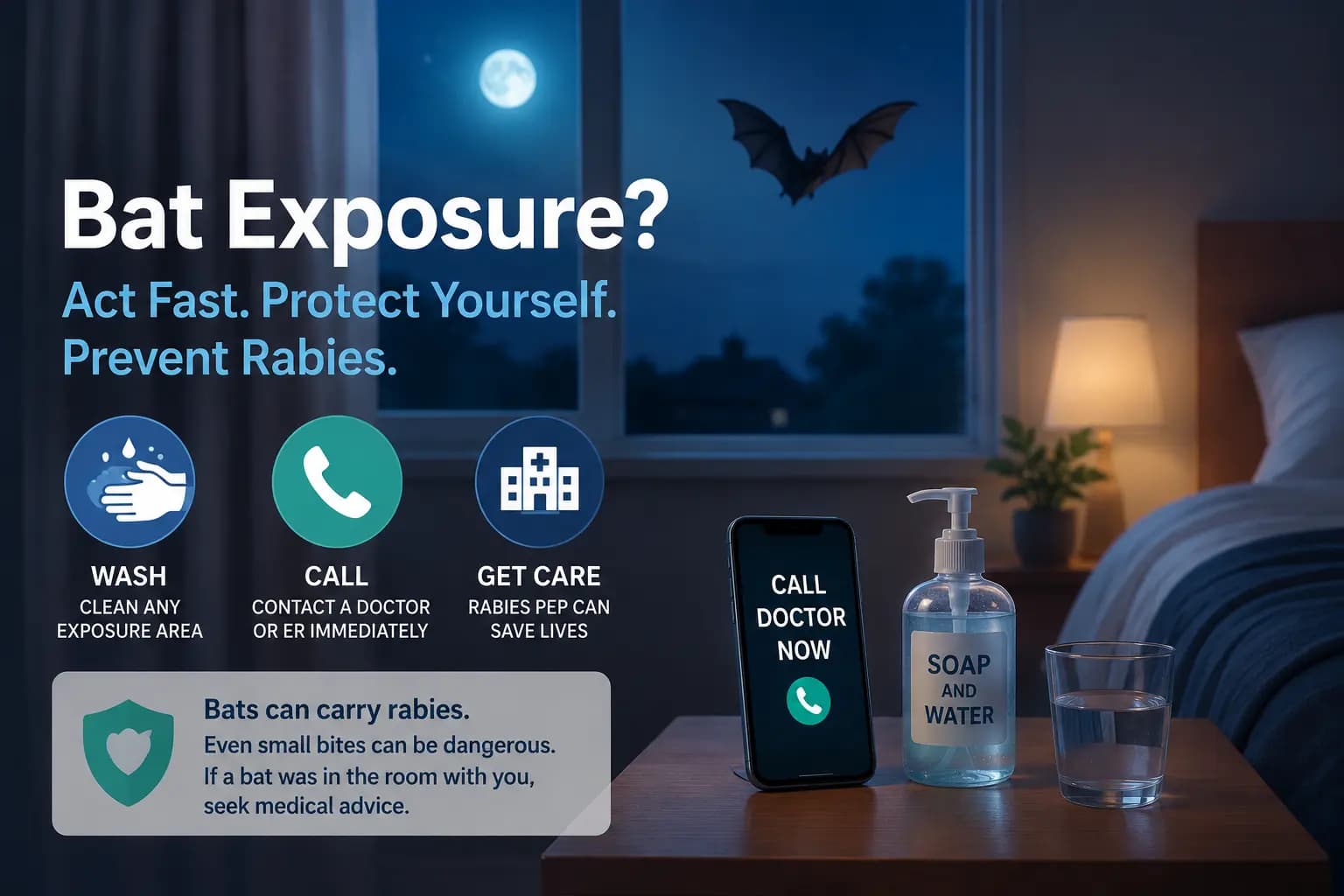
What to Do After Possible Bat Contact
Wash the wound immediately, avoid touching it, and seek prompt medical or public-health assessment. If time has passed, still seek guidance. Scroll down for the full step-by-step guide, or your local health department or a healthcare professional.

What Should You Do After Bat Exposure?
If you have been exposed to a bat, take these steps immediately — in order:
- Wash and flush the exposed area for about 15 minutes when possible — Use soap and running water. This physically reduces the viral load at the site and is your single most important immediate action.
- Do not rub or scratch the wound — Keep it clean and undisturbed until you reach a doctor.
- Seek prompt assessment from an ER, urgent-care centre, doctor, or public-health authority — Tell the doctor about the bat exposure and ask specifically about rabies post-exposure prophylaxis (PEP).
- Follow professional guidance if PEP is indicated — PEP may include rabies immune globulin (HRIG/RIG) and a vaccine series. If PEP is indicated, it should be given before symptoms begin. If time has passed, still seek professional or public-health guidance. Ask your local health department or a healthcare professional where to seek care. Call before traveling because vaccine, HRIG/RIG, hours, and services can change.
- Do not dismiss minor or unseen contact — If you cannot rule out bat contact, treat it seriously.

Bat exposure may seem harmless, but it carries a serious risk of rabies — a disease that is almost always fatal once symptoms appear. Even a small or unnoticed bite can lead to infection. A healthcare professional or public-health authority can assess the contact and advise whether PEP is indicated.
Can Bat Exposure Cause Rabies?
Yes. Bats are one of the leading carriers of rabies in many regions of the world. According to the World Health Organization (WHO) and the Centers for Disease Control and Prevention (CDC), rabies transmission from bats can occur through:
- Bites (even small, painless, or nearly invisible ones)
- Scratches that break the skin
- Contact with bat saliva on open wounds or mucous membranes
Even if you are unsure whether a bite occurred, medical evaluation is strongly recommended. For a broader understanding of how rabies spreads, see our guide to animal bites and rabies risk.
What Counts as Bat Exposure?
You may be at risk if any of the following apply:
- A bat touched or landed on your skin
- You woke up and found a bat in your room
- A bat was near a child, elderly person, or unconscious individual
- You handled a bat without protective gloves or equipment
- You found a bat near a sleeping child or infant

What If a Bat Touches You But Doesn’t Bite?
Any direct contact with a bat should be taken seriously. Bat claws can cause micro-abrasions too small to see, and bat bites are often painless and leave no visible mark. Saliva contact with broken skin or mucous membranes (eyes, nose, mouth) is considered a potential exposure by both the WHO and CDC. If a bat touched you, seek prompt medical or public-health guidance — do not wait to see if symptoms develop.
Why Bat Exposure Is Treated More Seriously Than Other Animal Bites
A bat flying outdoors is not the same risk as a bat found in a sleeping environment. What makes bat exposure different is that the contact itself is often subtle, confusing, or completely undetected.
Situations such as waking up with a bat in the room, finding one near a sleeping child, or discovering a bat around someone who cannot clearly describe what happened are treated as high-concern scenarios by public health authorities — even without a visible wound. Learn more about early symptoms of rabies in humans so you know what to watch for.
Symptoms of Rabies After Bat Exposure
Rabies symptoms may take weeks, months, or rarely longer to appear. However, once they begin, the disease is almost always fatal. Never wait for symptoms before seeking treatment.
Early symptoms may include:
- Fever and flu-like illness
- Headache and fatigue
- Tingling, itching, or burning at the exposure site
Advanced neurological symptoms include:
- Confusion and agitation
- Difficulty swallowing and fear of water (hydrophobia)
- Excessive salivation and partial paralysis
- Loss of consciousness
Do NOT wait for symptoms. Once rabies symptoms develop, there is no effective treatment.
Should You Go to the Hospital After Bat Exposure?
Yes — any of the situations listed above under "What Counts as Bat Exposure?" warrants prompt medical or public-health assessment. Use emergency services for severe bleeding or another immediate threat to life. Otherwise, seek prompt medical or public-health guidance about the appropriate care setting.
At the hospital, doctors will assess your exposure and may recommend:
- Rabies immune globulin (HRIG) — injected at the wound site on day 0, for unvaccinated individuals
- Rabies vaccine series — US schedule: 4 doses on days 0, 3, 7 and 14 for people never vaccinated and without an immune disorder; 2 on days 0 and 3 for qualifying previously vaccinated people. Immune disorders require a fifth day 28 dose, antibody testing and professional guidance
Not sure whether to go to the ER or urgent care? Read our dedicated guide: ER vs. urgent care for rabies exposure.

How Common Is Rabies From Bats?
Bats account for the majority of human rabies cases in the United States and are a significant source in many other countries. According to the CDC, most US human rabies deaths over the past two decades have been linked to bat variants of the virus — often because the person was unaware of the exposure or underestimated the risk. While only a small percentage of bats carry rabies, the near-certain fatality of untreated infection means any exposure must be evaluated.
Why Professional Assessment Matters
If rabies infection develops without treatment:
- The virus travels through the nervous system to the brain
- Severe neurological damage occurs
- The disease is almost universally fatal — with only a handful of documented survivors worldwide
Rabies is nearly always fatal after symptoms appear — but PEP is highly effective when given appropriately before symptoms begin. Unsure whether your exposure warrants treatment? Use our rabies exposure checklist.
Common Myths About Bat Exposure and Rabies
Myth: “If the bat looks healthy, it is safe.”
Fact: A bat can be infected with rabies and appear completely normal. Rabies status cannot be determined by observation alone.
Myth: “Rabies shots are dangerous and I should avoid them.”
Fact: Modern rabies vaccines are safe and effective. The series is given in the arm with generally mild side effects.
Myth: “A delay means professional guidance is no longer useful.”
Fact: If time has passed, still seek medical or public-health guidance. A professional should assess the exposure and decide whether PEP is indicated.
Myth: “Only a deep bite matters.”
Fact: Any bat contact — including micro-scratches and saliva on broken skin — can transmit rabies. See our rabies vaccine guide for what treatment involves.
How to Prevent Rabies After Bat Exposure
- Never handle bats with bare hands — use thick gloves or a covered container
- Seal entry points in your home to prevent bats from entering
- Vaccinate your pets (dogs, cats, ferrets) against rabies
- Teach children never to touch bats or unknown wildlife
- Seek medical care immediately after any possible exposure — do not wait
A Simple Bat Exposure Risk Guide
Low concern: You saw a bat flying outdoors with clearly no contact — this is not a rabies exposure.
Higher concern: The bat touched you, landed on you, or a bite or scratch may have occurred — needs prompt medical or public-health guidance.
High concern: You woke up with a bat in the room, a bat was near a sleeping child, or you cannot rule out contact — seek prompt medical or public-health assessment. If time has passed, still seek guidance. your local health department or a healthcare professional
Which schedule applies?
When PEP is indicated, the US schedule for someone never vaccinated and without an immune disorder is wound care, HRIG once, and vaccine on days 0, 3, 7 and 14. Day 0 is the first vaccine date, not necessarily the exposure date. Qualifying previously vaccinated people receive vaccine on days 0 and 3 without HRIG. Immune disorders require specialist guidance, a five-dose regimen through day 28 and antibody testing.
Prior PrEP or PEP records, completion of required PrEP follow-up, immune status and any care received abroad must be reviewed by the treating professional. Do not use a dose count to decide your own treatment. WHO-supported schedules can use different routes and visit counts outside the US. Discuss treatment changes or delays with the treating professional.
Sources: CDC US PEP guidance; ACIP PrEP follow-up guidance; WHO vaccine schedules.