
SafeRabies
Animal bite or possible exposure?Start emergency steps immediately →

Blog / Vaccines

🚨 High Risk Topic Medically Reviewed9 min read

Do Ferrets Need Rabies Shots? Vaccine, Law, and Bite Risk

Pet ferrets are susceptible to rabies and legally required to be vaccinated in many US states. Here is the schedule, approved vaccines, what to do after a bite, and how ferrets differ from dogs and cats.

By SafeRabies Editorial Team · May 23, 2026

Do Ferrets Need Rabies Shots? Vaccine, Law, and Bite Risk

Bitten or exposed? Act within hours.

Find Clinic →

Do This RIGHT NOW — 5 Immediate Steps

Read this before the full article. Readable in under 30 seconds.

  1. Step 1

    Wash the wound immediately

    Soap and water for 15 full minutes. This is the single most effective first action — it physically reduces viral load at the site.

  2. Step 2

    Call a doctor or ER now

    Describe the exposure. Don't wait for symptoms — rabies is nearly 100% fatal once they appear, but PEP is nearly 100% effective before.

  3. Step 3

    Start PEP the same day

    Post-exposure prophylaxis (rabies immune globulin + vaccine series) must begin before symptoms. Ask specifically about HRIG.

  4. Step 4

    Find a rabies treatment clinic

    Many ERs don't stock rabies vaccine. Use the SafeRabies clinic finder to locate the nearest centre that can treat you right now.

    Open Clinic Finder →
  5. Step 5

    Report the animal

    Contact animal control. If the animal can be observed or tested, its status may adjust your treatment plan.

Quick Answer

Yes — pet ferrets are susceptible to rabies and should be vaccinated. Rabies vaccination is legally required for ferrets in roughly 20 US states and in many county or city ordinances elsewhere. USDA-approved ferret rabies vaccines include IMRAB 3, Defensor 1 or 3, and Nobivac 1-Rabies. The first dose is given at about 12 weeks (3 months) of age, followed by annual boosters. After a bite incident, a healthy vaccinated ferret follows the standard 10-day observation rule.

Key Takeaways

  • Pet ferrets are mammals — they can get and transmit rabies.
  • Rabies vaccination is legally required for ferrets in roughly 20 US states and many local jurisdictions.
  • USDA-approved ferret rabies vaccines include IMRAB 3, Defensor 1/3, and Nobivac 1-Rabies.
  • First dose at about 12 weeks (3 months) of age, then annual boosters.
  • After a ferret bite, the standard 10-day observation rule applies — same as for dogs and cats.

The Short Answer: Yes

Pet ferrets are mammals, susceptible to rabies, and required by law to be vaccinated in many US jurisdictions. The American Veterinary Medical Association (AVMA), the National Association of State Public Health Veterinarians (NASPHV), and the American Ferret Association all recommend rabies vaccination for every pet ferret, regardless of indoor-only status.

Approximately 20 US states require ferret rabies vaccination at the state level, and many other states have county or city ordinances that mandate it. Beyond the legal requirement, an unvaccinated ferret involved in a bite incident faces dramatically worse outcomes than a vaccinated one — making the small annual vaccine cost an easy decision for responsible owners.

USDA-Approved Ferret Rabies Vaccines

Three rabies vaccines are USDA-licensed for use in ferrets in the United States:

  • IMRAB 3 (Merial / Boehringer Ingelheim) — the longest-standing ferret rabies vaccine and the most widely used.
  • Defensor 1 or Defensor 3 (Zoetis) — also USDA-licensed for ferret use.
  • Nobivac 1-Rabies (Merck) — additional licensed option.

Vaccines licensed for dogs but not specifically for ferrets should not be used. The product label and the legal protection it provides depend on USDA ferret-approval. Your veterinarian will use one of the approved products.

Ferret Rabies Vaccination Schedule

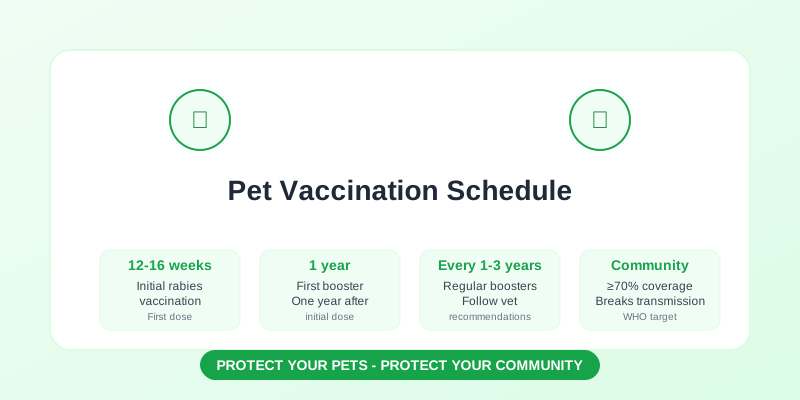
  • First dose: at about 12 weeks (3 months) of age — never earlier.
  • First booster: one year after the initial dose.
  • Ongoing boosters: annually thereafter.
  • Route: subcutaneous injection, 1 mL dose.
  • Administered by: a licensed veterinarian — required for legal certification.

Ferrets are not eligible for 3-year vaccine schedules — annual boosters remain the standard regardless of product. This is a key difference from dogs and cats, where 3-year products are widely used. See how long does the rabies vaccine last for the broader duration picture.

State Laws on Ferret Vaccination

Rabies vaccination law for ferrets varies more than for dogs and cats. The legal landscape breaks into three groups:

States Where Ferrets Are Legal and Vaccination Is Required

Roughly 20 states require ferret rabies vaccination at the state level, including most of the eastern US where ferrets are legal pets.

States Where Ferrets Are Legal but Vaccination Is Not State-Mandated

Some states leave it to local jurisdictions. County and city ordinances often fill the gap — check your local animal control or health department.

States Where Pet Ferrets Are Illegal

California and Hawaii prohibit pet ferrets entirely. New York City has a city-level ban even though New York state allows them. Several other jurisdictions have varying restrictions. If you live in one of these areas, owning a pet ferret carries legal consequences separate from any rabies discussion.

For broader state vaccination law context, see US rabies laws by state.

What Happens If a Ferret Bites Someone

Regardless of vaccination status, a ferret that bites a human is subject to public health observation. The protocol mirrors what applies to dogs and cats:

If the Ferret Is Currently Vaccinated

  • Standard 10-day observation at home under owner monitoring.
  • If the ferret remains healthy at day 10, it was not infectious at the time of the bite.
  • See the 10-day observation rule — the same framework applies to ferrets.

If the Ferret Is Unvaccinated or Overdue

  • Stricter quarantine — typically 4-6 months at the owner's expense in a licensed facility.
  • In some jurisdictions, euthanasia and rabies testing may be required.
  • This is one of the strongest practical arguments for keeping ferret vaccinations current.

For broader context, see do you need a rabies vaccine after a bite — the decision framework applies to ferret bites too.

What If Your Ferret Is Exposed to a Wild Animal

Ferrets, like cats, will engage with smaller animals if given the chance. A ferret that encounters a bat, raccoon, skunk, or fox should be assumed to have had exposure.

  • Vaccinated ferret: typically requires an immediate booster within 96 hours and strict quarantine for 6 months. Serologic testing may shorten the period in some jurisdictions.
  • Unvaccinated ferret: public health response is much harsher — strict 4-6 month quarantine or euthanasia.

This is stricter than the protocol for dogs and cats, where vaccinated animals typically get a 45-day home observation. Ferret protocols often require extended quarantine even for vaccinated animals because ferret rabies epidemiology is less well-characterised than canine or feline.

For bat exposure specifically, see bat exposure: what to do immediately.

Symptoms of Rabies in Ferrets

Rabies in ferrets follows a similar pattern to other carnivores, with both furious and paralytic presentations possible.

  • Sudden behavioural change — usually-friendly ferret becoming withdrawn or aggressive
  • Hyperactivity or unusual lethargy
  • Excessive salivation
  • Difficulty swallowing
  • Staggering, loss of coordination, or paralysis
  • Hindquarter weakness progressing to full paralysis
  • Vocalisation changes
  • Loss of fear and unprovoked biting

Rabies in ferrets, like in dogs and cats, cannot be definitively diagnosed in a living animal. Confirmation requires post-mortem brain tissue testing. Any ferret showing these signs should be evaluated by a veterinarian immediately, and any human or animal bites should be treated as potential exposures.

How Ferrets Differ From Other Pet Rabies Cases

  • Annual boosters only — no 3-year ferret product exists, unlike dogs and cats.
  • Stricter post-exposure quarantine even for vaccinated ferrets compared to vaccinated dogs and cats.
  • Variable legality — pet ownership itself is illegal in California, Hawaii, and some cities, which complicates everything else.
  • Smaller body size — vaccine dosing is fixed at 1 mL but ferrets weigh 1-4 pounds, so they receive a relatively larger per-weight dose than larger pets.
  • Outdoor exposure — pet ferrets that walk outside on harnesses can encounter the same wildlife as dogs.

Cost of Ferret Rabies Vaccination

Pricing closely mirrors what you would pay for a cat or small dog rabies vaccine:

  • County, shelter, or nonprofit clinics: $0-$15 per dose.
  • Mobile vet clinics at pet stores: $19-$28 per dose (where ferrets are accepted).
  • Private veterinary practices: $25-$50 per dose, plus exam fee.
  • Exotic vet specialists: often higher fees overall because of specialised training.

Not every vet treats ferrets — they are classified as exotic pets in most US practices. Find an exotic vet or one who specifically advertises ferret care. For broader cost context, see how much does a rabies shot cost.

Bottom Line

Pet ferrets need rabies vaccination — by law in many states, by common sense in all of them. The schedule is simple: first dose at 3 months, then annual boosters with a USDA-approved ferret rabies vaccine. After any bite incident or wildlife exposure, the practical and legal consequences for vaccinated versus unvaccinated ferrets differ dramatically — keeping the vaccination current is the simplest protection against worst-case outcomes.

For broader pet rabies guidance, see rabies vaccine for dogs and rabies injection for cats. For the full US vaccination law picture, see US rabies laws by state.

Don't Delay

Need a rabies clinic near you?

Find the nearest treatment centre — open now, in your area.

Find Nearest Clinic

Unvaccinated Ferrets Face Much Stricter Bite Outcomes

An unvaccinated ferret involved in a bite incident faces 4-6 month strict quarantine at the owner's expense or, in some jurisdictions, euthanasia and rabies testing. A vaccinated ferret follows the standard 10-day observation rule. Annual rabies vaccination is the simplest protection.

Ferret Rabies Vaccination Checklist

  • First rabies vaccine at about 12 weeks (3 months) of age
  • Annual boosters thereafter — no 3-year product exists for ferrets
  • Use a USDA-approved ferret rabies vaccine (IMRAB 3, Defensor, or Nobivac 1)
  • Confirm administration by a licensed veterinarian
  • Verify state and local legal requirements for ferret ownership and vaccination
  • Keep the rabies certificate accessible for licensing and travel
  • Schedule the annual booster — set a calendar reminder

Take the Next Step

Important Note

This article reflects current AVMA, NASPHV, and American Ferret Association guidance and is for educational purposes — it should not replace direct veterinary advice. State legality and vaccination requirements vary; pet ferrets are illegal in some US jurisdictions. Always confirm specific requirements for your location with a licensed veterinarian or your state public health office.

Frequently Asked Questions

Do ferrets need rabies shots?

Yes. Pet ferrets are susceptible to rabies, and vaccination is legally required in roughly 20 US states plus many county and city ordinances elsewhere. Beyond legal compliance, an unvaccinated ferret involved in a bite incident faces stricter quarantine outcomes than a vaccinated one. The American Veterinary Medical Association and American Ferret Association both recommend rabies vaccination for every pet ferret.

What rabies vaccines are approved for ferrets?

Three USDA-licensed rabies vaccines are approved for ferrets in the US: IMRAB 3 (Merial/Boehringer Ingelheim), Defensor 1 or 3 (Zoetis), and Nobivac 1-Rabies (Merck). Vaccines licensed for dogs but not specifically for ferrets should not be used because the legal protection and label timing depend on USDA ferret-approval.

When should a ferret get its first rabies shot?

The first rabies vaccine should be given at about 12 weeks (3 months) of age — never earlier. A booster is given one year later, then annually thereafter. Ferrets are not eligible for 3-year vaccine schedules, so annual boosters remain the standard regardless of which product is used.

What happens if my ferret bites someone?

A vaccinated ferret follows the standard 10-day observation rule — confined and observed for signs of rabies. If healthy at day 10, the ferret was not infectious at the time of the bite. Unvaccinated ferrets face stricter outcomes: typically 4-6 months of strict quarantine at the owner's expense, or euthanasia and rabies testing in some jurisdictions.

Are pet ferrets legal everywhere in the US?

No. Pet ferrets are illegal in California and Hawaii at the state level, and in some cities including New York City regardless of state law. Several other jurisdictions have varying restrictions. Before owning a pet ferret, verify legality with your state and local animal control.

How much does it cost to vaccinate a ferret against rabies?

Cat-and-small-dog ranges apply: $0-$15 at county or shelter clinics, $19-$28 at retail mobile vet clinics where ferrets are accepted, and $25-$50 at private veterinary practices. Exotic vet specialists may charge more overall. Not every vet treats ferrets — find one who specifically advertises ferret or exotic pet care.